Get your everyday column calculations done in minutes, with documentation a reviewer accepts the first time.
Set up the supports and loads, then check a section or find the optimal one. PolyColumn finds the buckling length for each load combination on its own, and runs a full biaxial verification. The documentation is a short PDF a reviewer can follow. PolyStruc runs every day at COWI, Artelia, Sweco, AFRY and NIRAS, and at 900+ universities.
PolyColumn supports steel, timber, and concrete columns and walls. Once you’ve picked a material, compare every section option side by side and pick the optimal one. For concrete, you can also optimize by cost or CO₂.
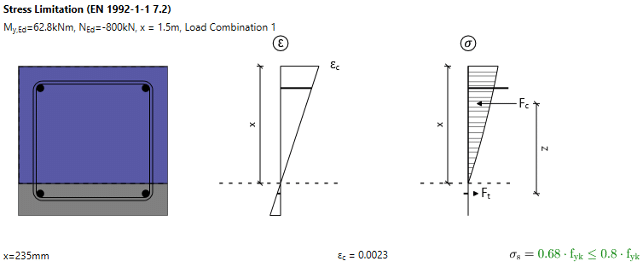
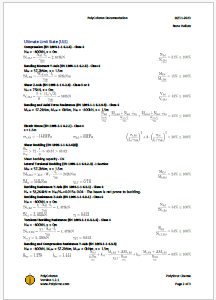
PolyColumn runs a full ULS check for steel, timber, and concrete columns and walls: cross-section checks for bending and shear, plus stability checks for buckling in steel and timber. Buckling length is found automatically for each load combination, not estimated by hand. For concrete, PolyColumn uses the general method instead of the simplified approach: UBAB cut reinforcement by up to 300% after switching. See the case.
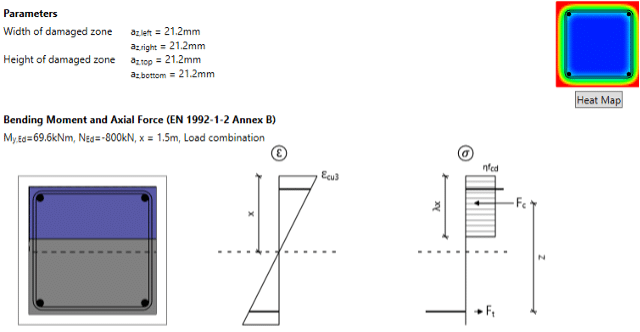
PolyColumn checks fire resistance for steel, timber, and concrete columns and walls: critical steel temperature for steel, reduced cross-section for timber (EN 1995-1-2), and the Zone Method for concrete (EN 1992-1-2 Annex B). Steel can be checked both unprotected and with fire protection applied, so you only add protection where it’s actually needed. See how it works.
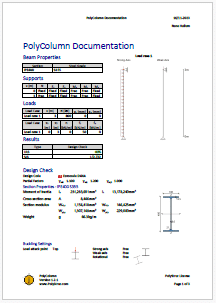
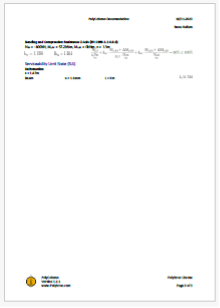
PolyColumn is desktop software for everyday column and wall design in steel, timber and concrete. It runs a full verification about both axes for reactions, shear, moment and deflection, and the full ULS, SLS and fire checks according to Eurocode, generating a short PDF report.
Steel, timber and concrete columns and walls in the same model, so you can compare materials directly.
Buckling lengths are handled automatically, determined through an eigenvalue calculation for every load combination. This avoids the common mistake of picking the wrong length by hand, and allows for better optimization.
PolyColumn uses the general method for concrete: covering both stiffness for second-order effects and biaxial bending through an iterative tilted neutral axis, instead of the simplified nominal-stiffness and §5.8.9 approaches.
Yes, for vehicle impact loads. Relevant for columns in a parking garage, or anywhere a vehicle could hit the structure.
Yes. For steel, PolyColumn calculates the steel temperature, and if protection is needed, finds the critical steel temperature needed to determine the necessary protection. Timber uses the reduced cross-section method (EN 1995-1-2), and concrete the Zone Method (EN 1992-1-2 Annex B).
PolyColumn designs according to Eurocode, either the base standard or with the Danish or Swedish national annex:
PolyColumn is kept up to date with Eurocode, and is being prepared for the second generation as it is introduced.
Yes, a C# API on NuGet (PolyColumn.Connector). You can define sections, loads and supports in code, batch-generate PDF reports, and pull sectional forces into your own tooling.
Anyone can create a free starter account, with all ULS, SLS and fire checks available on a single fixed section (HE300B). Students get full access to every feature for free with a student email, already used at 900+ universities worldwide.
Follow PolyStruc on LinkedIn for regular news and updates.
© 2026 PolyStruc