PolyBeam logo

Design statically indeterminate beams in steel, timber and concrete

Get your everyday beam calculations done in minutes, with documentation a reviewer accepts the first time.

The Everyday Beam Tool

Set up the supports and loads, then check a section or find the optimal one. PolyBeam runs a full verification for bending and torsion. The documentation is a short PDF a reviewer can follow. PolyStruc runs every day at COWI, Artelia, Sweco, AFRY and NIRAS, and at 900+ universities.

Sectional Forces & Reactions

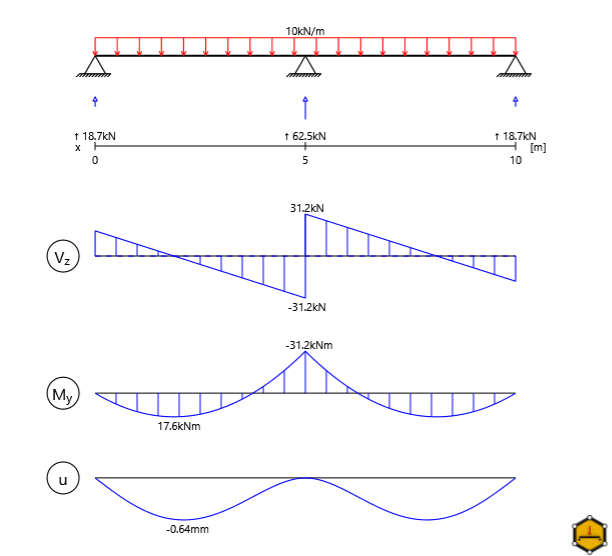
Set up supports and loads for a statically indeterminate beam in the beam calculator, and get reactions, shear, moment, torsion, and displacement immediately. Load combinations are optional: not required to determine the sectional forces, and can be skipped for a preliminary design too. Supports can also be modelled as plastic, capping pile reactions. See a real example.

Steel, Timber & Concrete

Compare steel, timber, and concrete sections for the same beam in one model, so you can show a client the trade-offs before committing to a material. Supplier beams like Deltabeams are included alongside standard sections. Once you’ve settled on a material, PolyBeam makes it fast to test many section options: VBK generates hundreds of HSQ combinations from one setup. See how.

Steel Section
Timber Section
Concrete Section

Ultimate Limit State

PolyBeam runs a full ULS check on steel, timber, and concrete beams: cross-section checks for bending, shear, and torsion, plus a stability check for lateral torsional buckling. The critical buckling moment is found through an eigenvalue calculation instead of a manual buckling-length lookup. See how it works.

Serviceability Limit State

PolyBeam checks deflection and natural frequency for steel, timber, and concrete beams. For concrete, it also checks crack width and reinforcement stress. Stiffness follows the moment distribution along the beam, giving a more accurate deflection, especially when deflection governs the design.
Fire

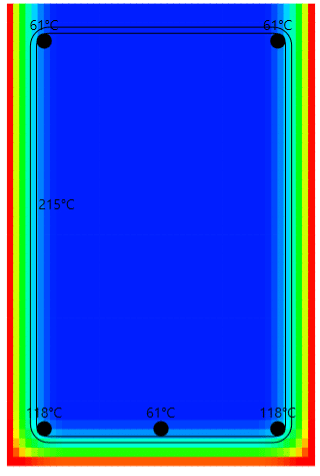
PolyBeam checks fire resistance for steel, timber, and concrete beams: critical steel temperature for steel, reduced cross-section for timber (EN 1995-1-2), and the Zone Method for concrete (EN 1992-1-2 Annex B). Steel can be checked both unprotected and with fire protection applied, so you only add protection where it’s actually needed. See how it works.

Documentation

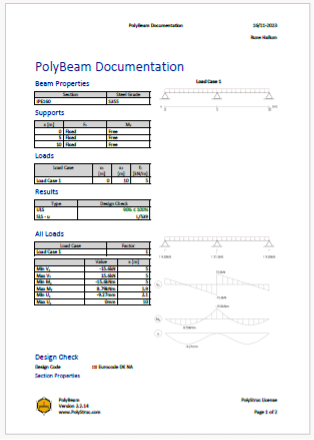
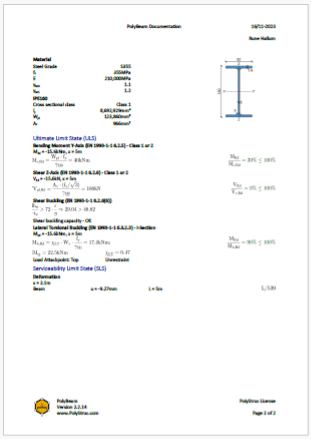
PolyBeam’s report is short and precise: inputs, diagrams, and results up front, the full Eurocode calculation behind them. One click to generate, with your own logo

The daily tool at Denmark and Sweden's leading consulting firms

PolyStruc customer - COWI
PolyStruc customer - AFRY
PolyStruc customer - Sweco
Norconsult
Artelia

Frequently Asked Questions

What is PolyBeam?

PolyBeam is desktop software for everyday beam design in steel, timber and concrete. It solves statically indeterminate beams for reactions, shear, moment and torsion, and runs the full ULS, SLS and fire checks according to Eurocode, generating a short PDF report.

Steel, timber, concrete and Custom Material, in the same model, so you can compare materials for one beam directly. Custom Material lets you enter your own parametric stiffness and capacity, with pre-loaded tables for common supplier beams such as Deltabeams already included.

Torsion from eccentric loading is common. PolyBeam calculates the torsional moment alongside shear and bending, and includes it in the full cross-section verification, a check many beam tools skip.

PolyBeam handles lateral torsional buckling automatically, using an eigenvalue calculation on the actual beam and loads instead of a manually assigned buckling length. This removes a common source of error: picking the wrong buckling length by hand.

Yes. PolyBeam runs the full serviceability check for steel, timber and concrete beams: deflection, natural frequency, and for concrete also crack width and reinforcement stress. Stiffness follows the moment distribution along the beam, giving a more accurate deflection when it governs the design.

Yes. Each support can be given a maximum compression capacity, redistributing load along the beam once that capacity is reached.

Yes. For steel, PolyBeam calculates the steel temperature, and if protection is needed, finds the critical steel temperature needed to determine the necessary protection. Timber uses the reduced cross-section method (EN 1995-1-2), and concrete the Zone Method (EN 1992-1-2 Annex B).

PolyBeam designs according to Eurocode, either the base standard or with the Danish or Swedish national annex:

  • EN 1990 for load combinations
  • EN 1992-1-1 and EN 1992-1-2 for concrete, and concrete in fire
  • EN 1993-1-1, EN 1993-1-2 and EN 1993-1-5 for steel, steel in fire, and plated (thin-walled) steel
  • EN 1995-1-1 and EN 1995-1-2 for timber, and timber in fire

PolyBeam is kept up to date with Eurocode, and is being prepared for the second generation as it is introduced.

Yes, a C# API on NuGet (PolyBeam.Connector). You can define sections, loads and supports in code, batch-generate PDF reports, and pull sectional forces into your own tooling.

Anyone can create a free starter account, with all ULS, SLS and fire checks available on a single fixed section (HE300B). Students get full access to every feature for free with a student email, already used at 900+ universities worldwide.

Try it on your next beam

Create a free account and run your own project. No credit card, and the starter license stays free.

Try it on your next beam

Create a free account and run your own project. No credit card, and the starter license stays free.

Looking for more?

PolyFrame Logo

Design and document steel-, timber frames with using PolyFrame.

PolyStringer logo
Design concrete shear walls and diaphragms using PolyStringer.
PolyWind logo
Determine wind loads on buildings with PolyWind.

Follow PolyStruc on LinkedIn for regular news and updates.

Request a demo